
How Bank Gambling Blocks Work and Who They Help
One of the most useful tools for anyone trying to step back from gambling is not a helpline or an app but something far more ordinary: a setting inside your own bank account. A growing number of banks now let customers switch on a gambling block that stops their card and account from being used to pay gambling businesses. It is free, it takes seconds to turn on, and for many people it is one of the most effective barriers available — precisely because it sits at the exact point where an urge becomes a transaction. Understanding how these blocks work, what they can and cannot do, and who benefits most from them is worth doing whether you are worried about your own gambling or supporting someone else.
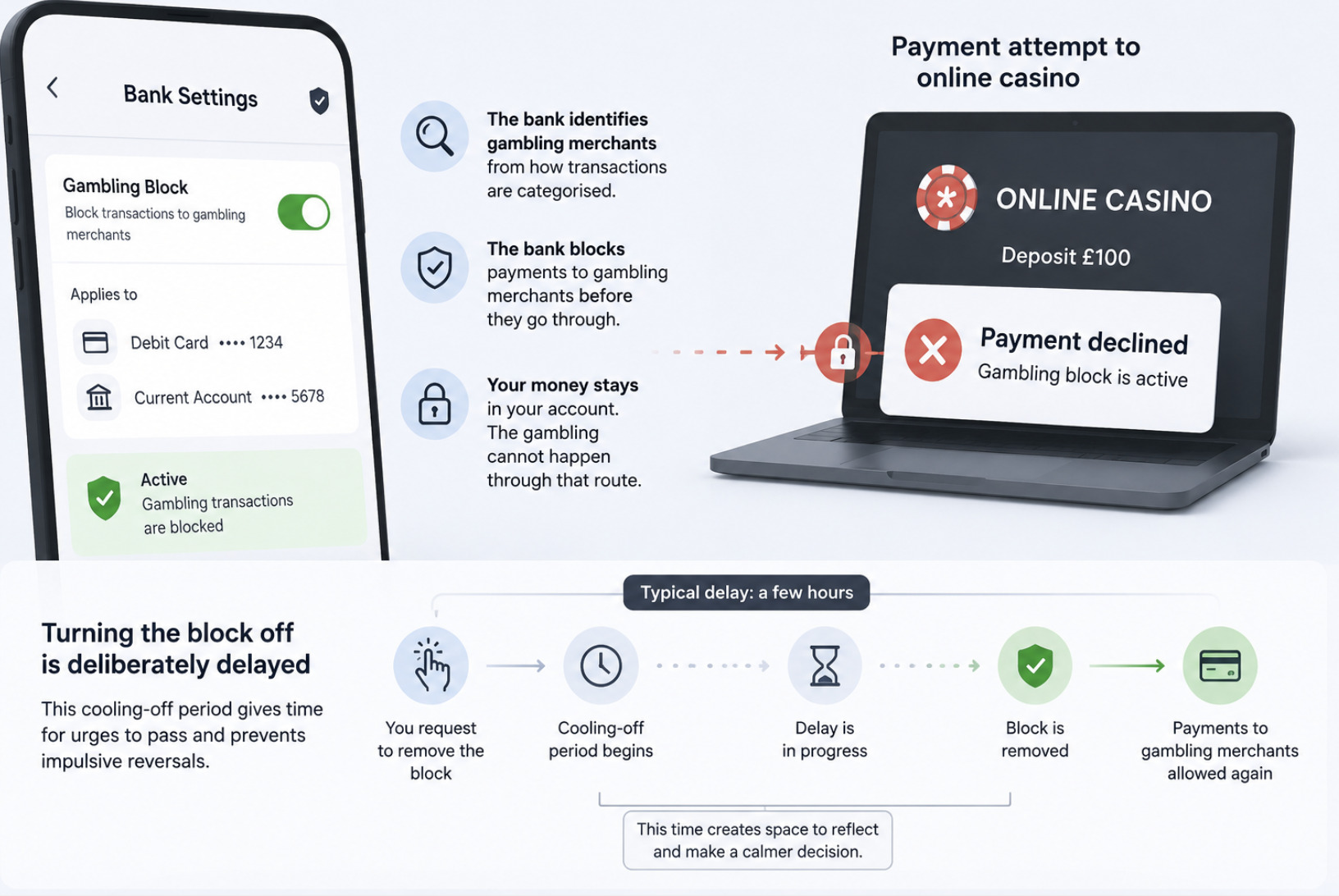
What a bank gambling block actually does
A bank gambling block is a control that instructs your bank to decline transactions to gambling merchants. When it is switched on, an attempt to deposit money to a betting site or online casino from that card or account is simply refused, in the same way a payment would be declined for any other reason. The block works because gambling businesses are identifiable to the bank through the way their transactions are categorised, so the bank can recognise a gambling payment and stop it before it goes through.
The power of this is in where it sits. Most tools for reducing gambling harm work on intention or willpower — deciding not to gamble, remembering to use a limit, choosing to stay away. A bank block works at the moment of payment, which is the last and most decisive step. However strong an urge is, if the money physically cannot leave your account to reach the gambling business, the gambling cannot happen through that route. The block turns a decision you made in a calm moment into an automatic barrier that holds even when the calm moment has passed, which is exactly what makes it so useful.
The delay that does the real work
One feature of these blocks matters more than any other, and it is easy to overlook: turning the block off is deliberately not instant. When a customer switches a gambling block on, removing it typically involves a delay — a cooling-off period of some hours before the block actually lifts, sometimes requiring a call or an extra step rather than a single tap. This is not a flaw or an inconvenience; it is the entire point of the design.
The reason is rooted in how gambling urges behave. The impulse to gamble is strongest in the moment and fades when given time, so a barrier that cannot be removed instantly is far more protective than one that can. If a block could be switched off in a second, it would offer little protection against a strong urge, because a person could simply disable it and gamble immediately. The built-in delay means that in the moment the urge is at its peak, the block stands firm, and by the time it could be lifted, the urge has often passed. That gap between wanting to remove the block and being able to is where the protection genuinely lives — it buys time, and time is frequently what allows an urge to subside. Recognising when those urges are becoming a problem is itself an important skill, one covered in how to recognise the warning signs of problem gambling.
Who benefits most
Bank gambling blocks are genuinely helpful for a wide range of people, but they are especially valuable for a few groups. For anyone actively trying to cut back or stop, the block is a practical, immediate barrier that does not depend on willpower in the hardest moments — it works precisely when self-control is most likely to falter. For someone in recovery, it removes one of the easiest routes back to gambling, closing a door that might otherwise be opened on a bad day. And for a person who has decided to self-exclude from gambling more broadly, a bank block is a powerful complement, reinforcing that decision at the level of their money.
The blocks are also useful in a quieter, preventive way. Someone who is not in crisis but simply wants to keep their gambling firmly under control can switch a block on as a boundary set in advance — a way of deciding, while clear-headed, that this route is closed. Because the block is free and easy to enable, there is little reason not to use it as a safeguard even before problems develop. It is worth being honest, though, that the people who benefit most are those who combine the block with other support rather than relying on it alone, which brings us to its limits.
What the block can't do
A bank gambling block is a strong tool, but it is not a complete solution, and using it well means understanding its boundaries. The most important limit is that a block on one account does not cover every possible route to gambling. A person could still use a different bank, another card, cash, or a payment method the block does not reach. This is not a reason to dismiss the block — closing one major, convenient route is genuinely valuable — but it is a reason not to treat it as a wall with no way around it. The block reduces access; it does not eliminate every path.
This is why blocks work best as one layer among several rather than a single fix. Combined with self-exclusion from gambling operators, with support from a professional or a helpline, and with the other practical barriers available, a bank block becomes part of a genuine structure of protection, each layer covering what the others miss. On its own it is a useful barrier; alongside support that addresses the underlying difficulty, it is far more powerful. Turning one on is a strong and practical step, and it pairs naturally with reaching out for help — the first move described in the first steps toward getting help for gambling harm.
A simple step worth taking
For all its limits, the bank gambling block deserves to be far better known than it is, because it is one of the rare harm-reduction tools that is free, immediate, and genuinely effective at the decisive moment. Switching one on is a small action with a real protective effect: it places an automatic barrier between an urge and a transaction, holds firm through the built-in delay when willpower is weakest, and reinforces any wider decision to step back from gambling. For anyone who has ever felt their gambling slipping beyond where they want it, it is one of the easiest and most practical things they can do today.
Frequently asked questions
What is a bank gambling block? It is a free setting offered by many banks that instructs the bank to decline transactions to gambling businesses from your card or account. When switched on, attempts to pay a betting site or online casino are refused, placing an automatic barrier at the exact moment a payment would be made.
Why can't I turn a gambling block off instantly? By design. Removing the block usually involves a delay or cooling-off period rather than a single tap, because gambling urges are strongest in the moment and fade with time. A barrier that can't be lifted instantly stays firm when an urge peaks, and often the urge passes before the block can be removed — which is the protection working as intended.
Does a bank gambling block stop all gambling? No. A block on one account doesn't cover every route — a person could use another bank, card or cash. It closes one major, convenient path, which is genuinely valuable, but it works best as one layer alongside self-exclusion and support rather than as a complete solution on its own.