
The Dark Playbook. How Offshore Online Casinos Engineer Players Into Gambling More
Offshore online casinos operate outside meaningful regulation, and they've built an arsenal of psychological and financial tactics designed to keep players depositing. A field guide to the practices a player will encounter — often within minutes of signing up.
The Dark Playbook: How Offshore Online Casinos Engineer Players Into Gambling More
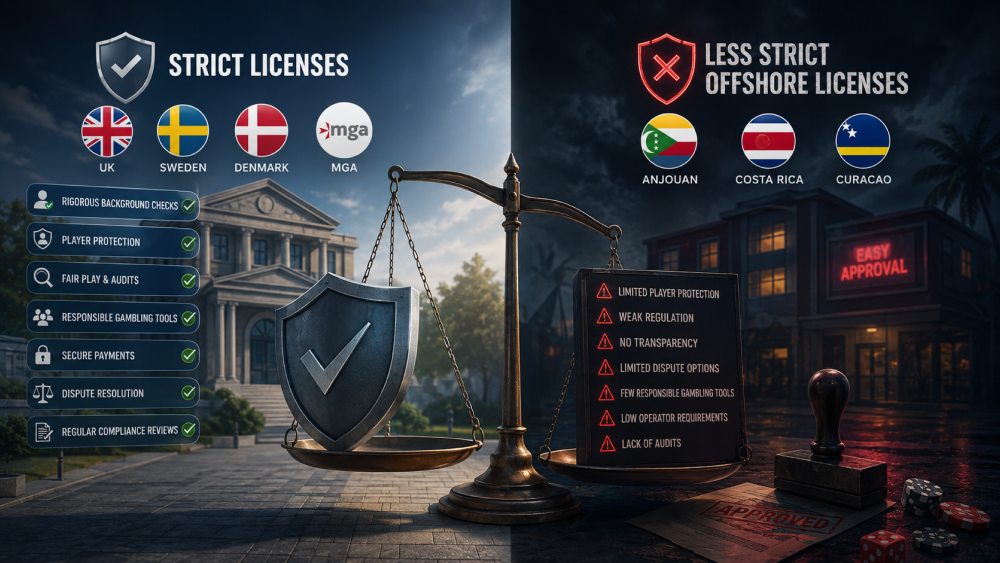
Licensed gambling operators in regulated markets — the UK, Sweden, Germany, parts of the United States — are subject to advertising codes, affordability checks, self-exclusion systems, and audited game mechanics. Offshore online casinos, the ones flashing through banner ads and influencer streams under licenses from Curaçao, Anjouan, or Costa Rica (like Spinboss), are subject to almost none of it. They are not bound by the rules that exist to protect players from themselves, and they have spent two decades refining tactics designed to do the opposite: extract as many deposits as possible, for as long as possible, from each person who signs up.
What follows is not a comprehensive list. It is a field guide to the most common practices a player will encounter, often within minutes of creating an account.
The Bonus Is Not a Gift
The headline "200% welcome bonus up to $5,000" is the front door. The terms are the trap.
Almost every offshore casino bonus carries a wagering requirement — typically 30x to 70x the bonus amount, sometimes the bonus plus the deposit. A $200 deposit that triggers a $400 bonus with 40x wagering means the player must place $16,000 in bets before any winnings can be withdrawn. Most players cannot do this without depleting the balance entirely, which is exactly the point. The bonus is designed to be wagered to zero.
Sticky bonuses go further: even if the player wins, the bonus amount itself can never be withdrawn — only profits derived from it, after wagering is cleared. Cashback offers trigger only on losses, conditioning the player to see losing as partially refundable, and giving them fresh chips with which to keep playing. Free spin packages and reload offers are routinely targeted at dormant accounts, including those of players who quietly self-identified as having a problem before drifting back.
Game Mechanics Built to Mislead
Slot games at offshore casinos lean heavily on three documented design patterns that exploit how the brain processes reward.
The near-miss displays two jackpot symbols and a third just above or below the payline. Functionally, it is a loss. Neurologically, brain imaging studies have shown it activates reward pathways almost identically to a real win. Players consistently play longer after near-misses than after clean losses, and the frequency of near-misses in modern slot software is calibrated, not coincidental.
Losses disguised as wins occur when a player bets, say, $2 across multiple paylines and "wins" $0.40 — a net loss of $1.60 — while the screen erupts in celebratory animation, coin sounds, and flashing lights. The nervous system registers a win even as the balance drops.
Autoplay and turbo modes strip out the pauses that normally let a player notice how much they have lost. A slot that takes four seconds per spin manually takes under one second on turbo, compressing an hour of losses into ten minutes — without ever giving the player a moment to reconsider.
The VIP Funnel
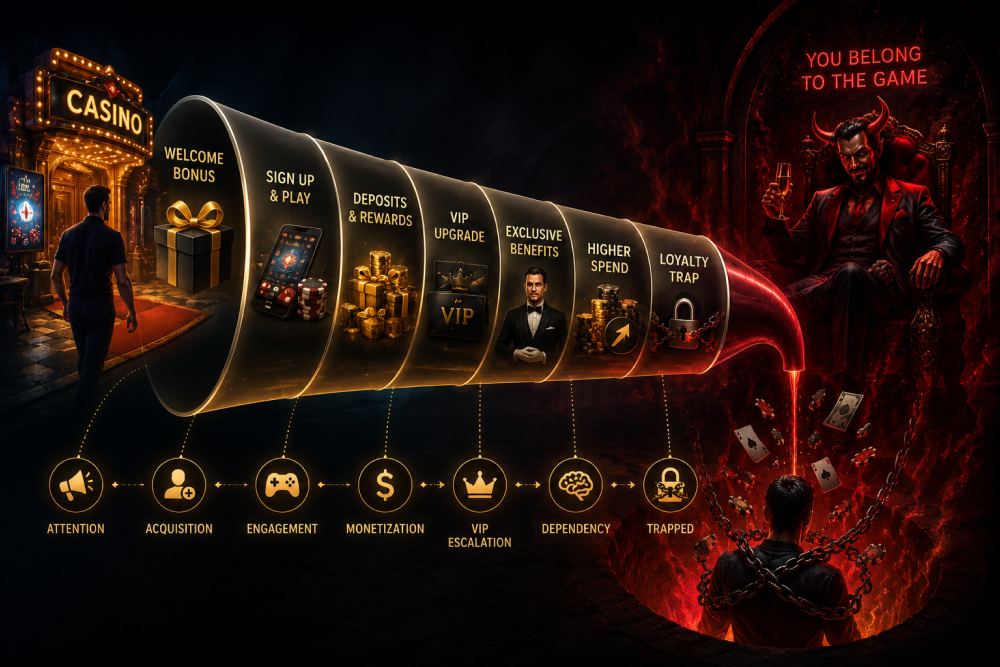
Players who deposit heavily are quickly assigned a personal account manager who emails, texts, and sometimes calls them. The relationship is engineered to feel like friendship. The manager remembers birthdays, offers "exclusive" reload bonuses after losing streaks, and — crucially — knows exactly when the player is about to log off.
Internal documents from offshore operators that have surfaced in regulatory cases and lawsuits show VIP programs explicitly trained to identify chasing behavior — increasing bet sizes after losses — and respond by extending more credit and richer bonuses, not less. The most loyal customers, in the industry's own internal terminology, are the ones losing the most. There is no contradiction in that sentence from the operator's side. It is the business model.
Friction Where It Hurts You, Smoothness Where It Helps Them
Depositing is instant. Crypto, cards, e-wallets, prepaid vouchers — money flows in seconds and with minimal verification. Withdrawing is the opposite.
The reverse withdrawal window is the cleanest example. A player requests to cash out $1,000. The casino marks it "pending" for 24, 48, or 72 hours, during which the player can cancel the request and play the balance again. A substantial percentage do. Some operators only request KYC documents at the withdrawal stage, not the deposit stage, adding further days of delay during which the urge to play creeps back. Others split withdrawals into small weekly tranches, leaving most of the balance trapped on the platform and reachable from the lobby with a single click.
Bypassing the Few Protections That Exist
Self-exclusion programs like the UK's GamStop only bind licensed operators. Offshore casinos actively market themselves to self-excluded players, explicitly advertising the ability to "bypass GamStop" as a feature. Crypto deposits route around the bank-level gambling blocks that many recovering players install on their own accounts — one of the few effective harm-reduction tools available. Fake or near-meaningless licensing badges, particularly under the legacy Curaçao master license model, give the appearance of regulation without the substance: no real affordability oversight, no enforced complaints process, no audited game fairness.
What to Watch For
A player, or someone watching a loved one's behavior, should treat these as warning signs of an operator built to harm rather than entertain:
Aggressive bonus offers with wagering terms buried in fine print
A personal "host" or "VIP manager" who contacts the player directly
Withdrawal delays that allow cancellation
Crypto-only payment options framed as "convenience" or "privacy"
Any platform that accepts deposits from someone who has previously self-excluded elsewhere
Reload offers and free spins that arrive precisely when the player has been trying to stop
None of this is accidental. The practices above are not bugs in the offshore casino model — they are the model, refined deliberately over two decades. Recognizing them is the first step in refusing to play the game on the operator's terms, and the first step in helping someone else do the same.